The Woman Who Forgot She Was on the List
The Woman Who Forgot She Was on the List
You know how to do everything for everyone else. You know the pediatrician's number by heart, your parent's medication schedule, your partner's stress triggers, the school pickup rotation, the birthday you can't forget, the deadline at work you absolutely cannot miss. You have run a household, a career, a family, sometimes a marriage, sometimes a business- all at once, for years- and you have done it well enough that most people around you have no idea how much it costs you.
Here's what nobody tells you about being the person who holds everything together: somewhere in all that holding, you quietly disappeared from your own list of people worth taking care of.
If you're in your 40s or 50s and reading this, you probably know exactly what I mean. You didn't decide to stop prioritizing yourself. It happened one skipped lunch, one canceled workout, one "I'll deal with that later" at a time, until later became never, and taking care of you became the thing that only happens if there's anything left over. And there is rarely anything left over.
The exhaustion that isn't really about sleep
You're tired in a way that a good night's sleep doesn't fix. It's not just physical, it's the fatigue of being needed by everyone, all the time, in a hundred small ways that never show up on anyone's radar but yours. You feel it in your body: the stiffness, the way your energy crashes by 3pm, the way your clothes fit differently than they used to and you're not even sure when that happened because you haven't had a spare minute to think about it. You feel it emotionally, too. A low hum of resentment you feel guilty for even having, because everyone you take care of is someone you love.
And underneath the exhaustion is something quieter and harder to say out loud: a sense that you've become invisible to yourself. You can tell me everything about the people you love- their favorite foods, their fears, what they need to feel okay- and struggle to answer a simple question about your own body. When did you last eat something because it nourished you, not because it was fast, easy, or the only thing left in the fridge after everyone else ate? When did you last move your body for you, not to burn off a bad day or punish yourself for a plate of nachos?
Food becomes another thing you're failing at
For so many women in this stage of life, food turns into a quiet battlefield. You know the "right" things to eat. You've read the articles, tried the apps, maybe done a cleanse or two. But knowing what to eat and actually eating it are two different problems when you're running on fumes and decision fatigue by 6pm. So dinner becomes whatever's fastest. Or you skip meals because there's no time, then overeat later because your body is finally getting a say. Or you eat standing at the counter, alone, after everyone else has gone to bed, and it doesn't feel like nourishment- it feels like the only five minutes of the day that belonged to you.
This isn't a willpower problem. It's a bandwidth problem. You are not lacking discipline. You are lacking a system that accounts for the actual shape of your life- one that doesn't require two hours of meal prep on a Sunday you don't have, or a level of restriction that just adds another layer of stress to a nervous system that's already maxed out.
Why strength training changes something that dieting never could
Here's the shift that changes everything, and it usually isn't the one people expect: it's not about eating less. It's about lifting weights.
Somewhere in your 40s, your body starts losing muscle mass whether you do anything about it or not- a slow decline that speeds up through perimenopause and beyond. That muscle loss is quietly behind a lot of what feels wrong: the slower metabolism, the softer strength, the fatigue, the way your body seems to hold onto weight no matter what you cut out. Cardio and calorie-cutting alone don't fix this. Strength training does.
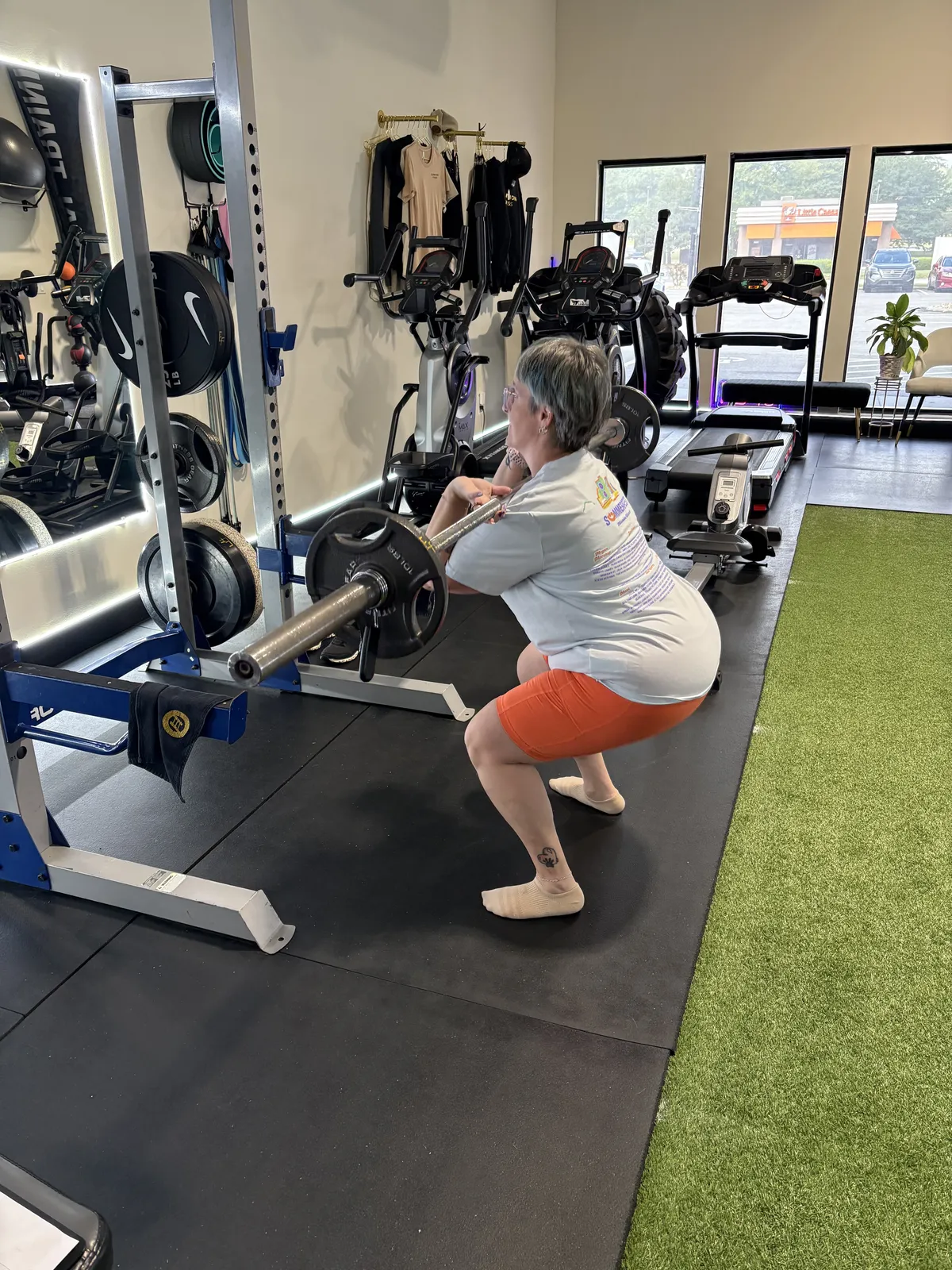
But the physical changes, real as they are, aren't even the most important part. Something happens in a woman's mind when she starts getting stronger in a squat rack or with a set of dumbbells in her own living room. For maybe the first time in years, she is doing something that is entirely, unapologetically for her. Nobody needs anything from her during that 30 minutes. There's no multitasking, no one to take care of, nothing to fix for someone else. It is hers.
And strength training gives you something dieting never has: proof. You don't have to hope you're making progress and wonder if it's working. You add five more pounds to the bar. You do one more rep than last week. You carry the grocery bags without your shoulder aching. You get up off the floor without thinking about it. That evidence- visible, measurable, undeniable- starts to rebuild something that years of self-neglect wore down: the belief that you are capable, that your body is not something to manage or hide or apologize for, but something you can actually trust again.
Nutrition, done differently
Once strength training is part of your life, nutrition stops being about restriction and starts being about fuel. The question shifts from "what am I allowed to eat" to "what does my body need to recover and get stronger." That's a completely different relationship with food. One built on enough protein to support the muscle you're building, enough real food to have energy for your actual life, and enough flexibility that a birthday cake or a glass of wine with a friend doesn't derail you or trigger guilt. It's sustainable specifically because it isn't punishing. You're not white-knuckling your way through a diet; you're feeding a body that's doing real, visible work.
This is not one more thing on the list
I know what you're thinking, because I hear it from women like you constantly: I don't have time for one more thing. And I want to be honest with you, this can't be one more thing you squeeze in and resent. It has to be the thing that changes how everything else feels. Thirty minutes, three times a week, of strength training and a way of eating that actually supports your real life, is not a burden on top of an already full plate. It's the thing that makes you more capable of carrying everything else, such as, more energy for your kids or grandkids, more patience at work, more resilience for whatever the day throws at you, a body you can rely on for the next 40 years instead of one that's quietly breaking down.
You are allowed to be on your own list
If you've spent your 40s or 50s taking care of everyone but yourself, this isn't a guilt trip about how you should have started sooner. You did what the moment required, and that took real strength. But you get to decide, starting now, that your health isn't the thing you'll get to eventually. It's not selfish to prioritize it, it's the foundation that lets you keep showing up for everyone you love, for decades to come.
You don't need to overhaul your entire life overnight. You need one place to start: pick up something heavier than your purse, twice this week, and pair it with meals that actually fuel you instead of just getting you through the day. That's it. That's the whole shift, at the beginning. Everything else builds from there.
You've spent your whole life proving you can take care of everyone else. Now it's time to prove you can take care of you too.
